








If you are not well aware of the parcel measuring techniques of courier companies, then the total shipment price may shock you. You might be shipping feathers (we hope not!) and still get a shipment rate higher than others. This happens when you do not understand volumetric weight that well. And when you need the details, we come here to guide you.
The modern couriers rely on volumetric weight computation to determine and provide you with the total shipping costs. The volumetric weight, also known as the dimensional weight, is the calculation of the shipping cost of a package as per its size or volume, rather than tha actual weight. In this case, you get billed for how much space your parcel takes in the courier vehicle. This is to ensure that lightweight items do not take up large spaces where smaller packages could be kept easily.
Key Takeaways
- Your shipping charges will be based on the volumetric weight of your parcel, i.e, how much space they occupy. In some cases, physical weight may also be calculated.
- To determine the volumetric weight, it is significant to calculate the parcel dimensions instead of the physical weight.
- A specific formula is used by the couriers to compute volumetric weight and determine how much they will charge you.
- Before you book a shipment, it is better to use a volumetric weight calculator for the most accurate chargeable numbers.
- It is easy to reduce this volumetric weight if you carefully proceed with optimised packaging.
Why Volumetric Weight Makes Your Parcel Shipping More Expensive
The more the volumetric weight, the more would be your shipping charges. This happens because cargo vehicles have a limited space, and it gets difficult to accommodate more packages if the volumetric weight is higher.
You can take the example of a light-weight, fluffy toy that may weigh even less than a kilogram, but with bulky packaging, would take more space, which could have been used to fill up small packages. Here’s when courier companies determine pricing via volumetric weight by calculating dimensions.
To reduce these excess charges, optimised packaging must be done instead of big and bulky parcels.
How Couriers Determine Chargeable Weight: Volumetric Weight vs Actual Weight
The weight calculation by couriers is based on these two types:
- Actual Weight– It is the physical weight that can be measured on a scale
- Volumetric Weight– In this, the dimensional weight is considered for determining charges.
Once both these weights are calculated, the courier charges the value that is higher between them. This is what we know as volumetric weight computation. For example-
Actual Weight = 4kg
Volumetric Weight = 7kg
Here, the courier will charge based on 7kg. This shows how important it is to calculate volumetric weight beforehand to avoid unexpected charges.
How to Calculate Volumetric Weight
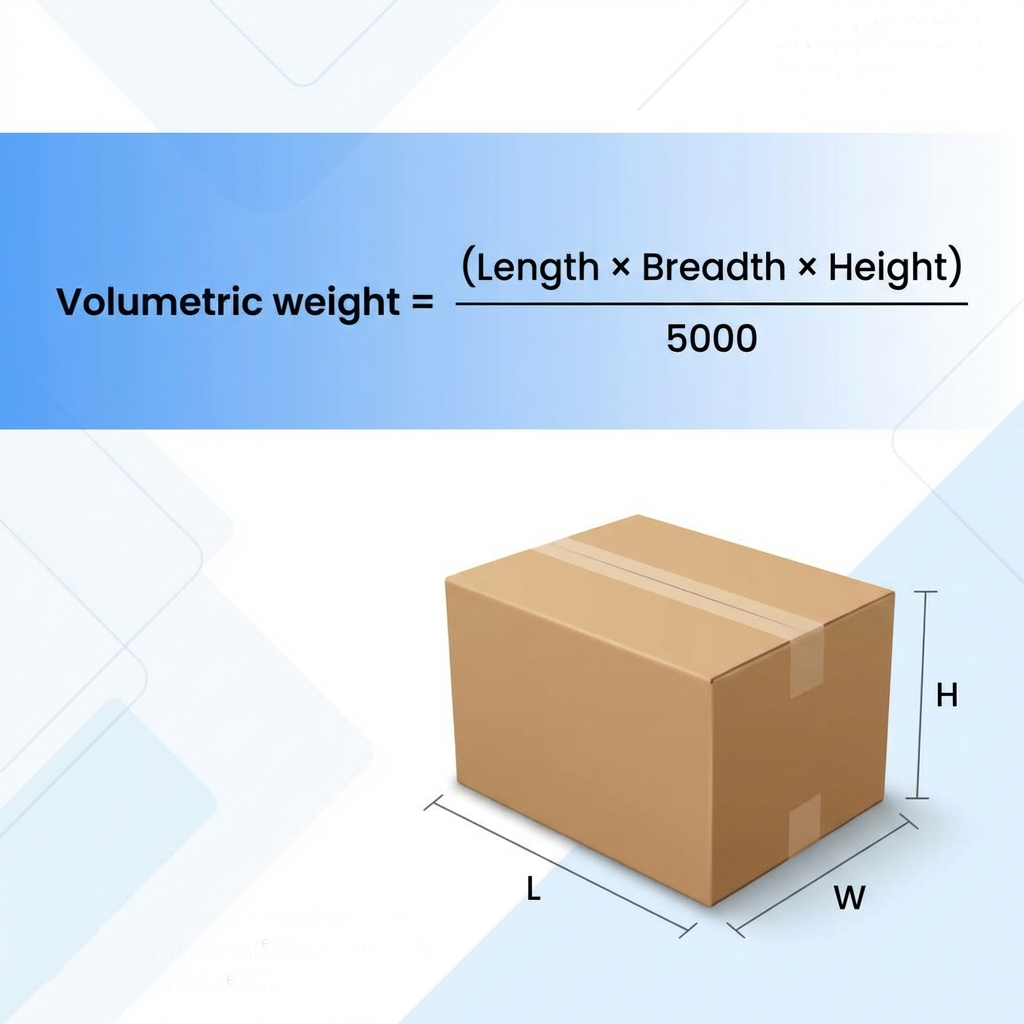
We are making the calculations easier for you!
STEP 1- Measure Parcel Dimensions (Length x Width x Height)
You have to start the first step by measuring the dimensions of your parcel in either centimetres or inches. Make sure you take accurate measurements, as even a minor difference can greatly affect the final result.
For example, let’s take these values as our parcel dimensions.
- Length: 40cm
- Width: 30cm
- Height: 20cm
These dimensions will then be used in the specific formula for volumetric weight computation.
STEP 2- Apply the Volumetric Weight Calculation Formula
After measuring the dimensions, it is time to apply the volumetric weight formula, which is the standard courier formula.
(Length x Width x Height) ÷ Volumetric Divisor
This formula is part of the standard volumetric weight conversion process, which is used by many logistics companies worldwide.
Volumetric Weight Calculation Formula Used by Couriers
If you too wanted to know how do i calculate volumetric weight, then this simple formula is all you need.
Volumetric Weight (kg) = (Length x Width x Height) ÷ Divisor
Which is-
Volumetric Weight (kg) = (L x W x H in cm) ÷ 5000
Applying the formula in the example we discussed above-
40 × 30 × 20 = 24,000
24,000 ÷ 5000 = 4.8 kg volumetric weight
This is how you can use this formula to calculate volumetric weight of your parcel.
Example Calculation For Volumetric Weight
We are taking another example for you to understand these calculations better.
Parcel details:
- Length: 50 cm
- Width: 40 cm
- Height: 30 cm
Step 1 – Multiply dimensions:
50 × 40 × 30 = 60,000
Step 2 – Divide by courier divisor:
60,000 ÷ 5000 = 12 kg
We mentioned earlier that couriers will charge you as per whichever weight is higher, physical weight or volumetric weight. Here we got volumetric weight as 12kg, if the physical weight of the same parcel is around 8kg, then you will be charged as per the volumetric weight. If the physical weight were higher, then you would be charged accordingly.
Common Divisors Used In Volumetric Weight Computation
Although this is the general formula used for volumetric weight calculation, different courier services might use different divisors for this calculation.
Here are the commonly used divisors.
- 5000 – Standard for air freight and express shipping
- 6000 – Sometimes used for international logistics
- 4000 – Occasionally used for domestic shipments
Do check the specific divisors for the courier you are selecting, as these variations may lead to differences in volumetric weight conversions.
Volumetric Weight Conversion Methods (Metric and Imperial)
Shipping industries operate at a global level, and thus, when it comes to volumetric weight conversions, they may use either Metric or Imperial systems.
Metric System
Formula:
(L × W × H in cm) ÷ 5000
Imperial System
(L × W × H in inches) ÷ 139
Both these formulas can help calculate volumetric weight accurately.
Using a Volumetric Weight Calculator to Estimate Shipping Cost
If you, too, try to avoid calculation every time, like me, or have a great number of packages to ship and do not want to measure and calculate every time, then you can take help from volumetric weight calculator.
With the help of these tools, you can-
- Calculate the volumetric weight instantly and easily
- Get an estimate of total shipping costs
- Compare the packaging sizes
- Avoid unexpected courier charges
These can be helpful, especially for e-commerce businesses that ship a large volume of packages regularly.
Tips to Reduce Volumetric Weight and Lower Shipping Costs
The best way to lower your shipping charges is to reduce the parcel size. Here are some tips that can be significant for you.
- Use Right-Sized Packaging – If you are shipping small items, then don’t choose an oversized box for them. They will take up space and increase the charges.
- Compress the Soft Items – You can try vacuum packaging for clothing, textiles or other kinds of soft items.
- Remove Excess Fillers – Understand that too much padding can increase the volumetric weight unknowingly. Remove the excess fillers.
- Use Custom Packaging – Businesses can customise the packaging boxes themselves that can perfectly fit their products.
Optimise the packaging this way and reduce the logistics expenses.
FAQs
What is the difference between volumetric weight and actual weight?
Actual weight is the physical weight of a package. Like when you place a package on a weighing scale, and the number it shows is the actual mass of the package. Volumetric weight, on the other hand, is how much space your parcel will occupy in the courier vehicle. Couriers measure both these values and charge as per which one is higher.
How to convert volumetric weight to kg?
If you want to convert volumetric weight to kg, you will need to use the volumetric weight conversion formula.
(L × W × H in cm) ÷ 5000. This will convert the dimensions into kg.
What makes shipping more expensive, size or weight?
Couriers consider both these factors while charging you. However, big and bulky parcels will definitely cost you more, as they take up more space in transport and are charged based on volumetric weight.
When to use volumetric weight?
If the package’s dimensions take up more space and the value is higher than the physical weight, then the parcel’s volumetric weight is used.
Conclusion
If you are a regular shipper, you must understand the difference between actual or physical weight and volumetric weight, and when each is used. We have discussed the conversion formulas, and when you can expect volumetric weight to be considered. Have more doubts? Get in contact with courier experts at DTDC Australia.